
What Are Genuine Natural Stones?
Share
At Priscilla Sayegh jewelry, we often incorporate genuine natural stones, and we'd like to explain what they are and how they're obtained.
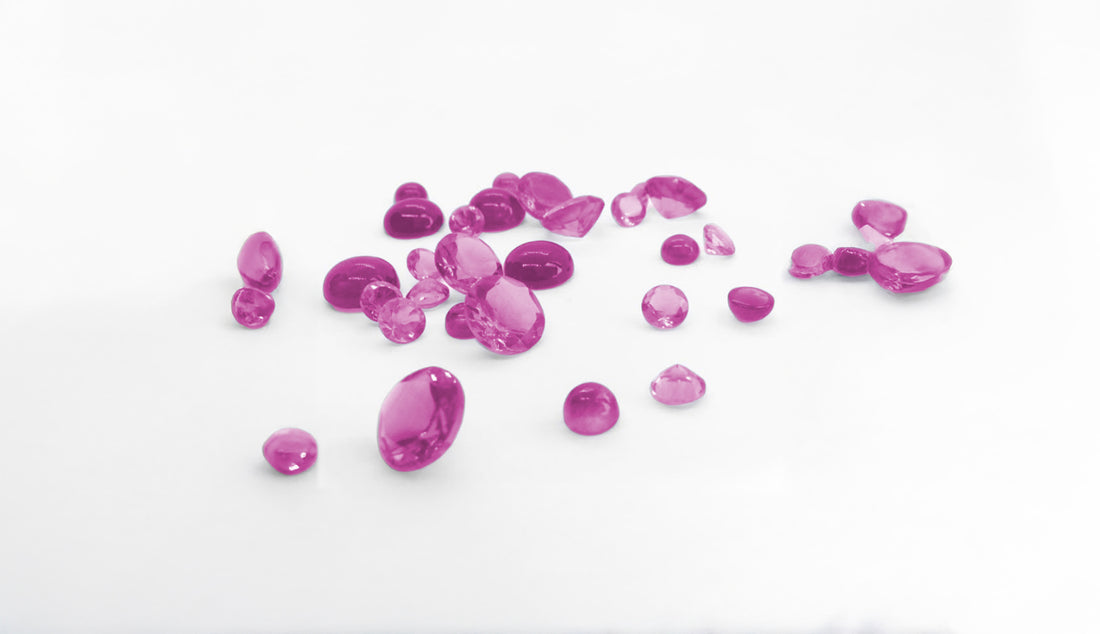
We'll use the Swarovski Pink Sapphire as an example.
Nature at its finest uses intense heat and pressure, along with a mix of aluminum, oxygen, and chromium. This raw pink sapphire is a member of the corundum mineral family. Pink sapphires and rubies are actually identical materials, differing only in the depth and saturation of their color, and are found mainly in East Africa, Madagascar, Myanmar, and Vietnam. In fact, ruby is the birthstone for July, and sapphire for September.
This is what pink sapphires look like when rough — after being extracted, cleaned, and roughly sorted by color and size. An important fact: out of 500 kg of extracted material, only a few grams of gem-quality stones suitable for cutting and jewelry can be produced. Pink is one of the rarest colors for sapphires, and the stones come in light pink, strong pink, and purple-pink. The brighter and more intense the color, the more valuable the stone.
Now it comes down to science and math. Experts define the optical axis of each stone during pre-forming and calibrated cutting. They establish an angle of exactly 90° relative to the optical axis, where the first facet is cut by highly skilled staff at the international Swarovski company. This brings out the most perfect and even color in each gemstone. The stones are then calibrated by high-tech machinery that shapes the final form.
Swarovski uses proprietary, state-of-the-art technology to cut the sapphires, so each individual stone has perfect proportions and precise facet geometry. The gemstones are then sorted by color. Here at Priscilla Sayegh, designers and jewelers around the world love these Swarovski gemstones for their intense brilliance, color consistency, and exact cut.
You can learn more about the types of genuine natural stone we have available by writing to: info@priscillasayegh.com