
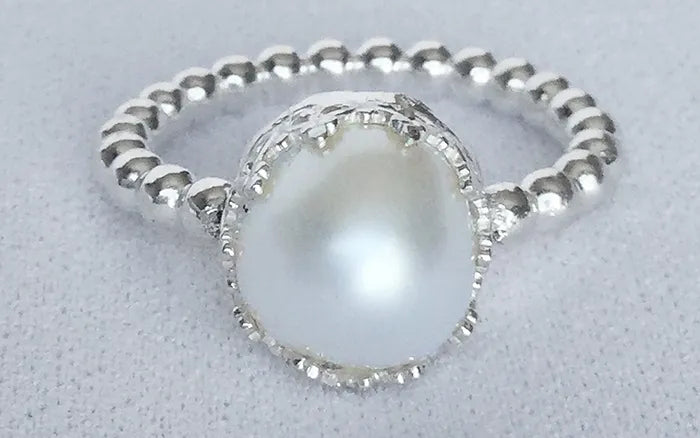
6 Jewelry Beliefs and How to Use Them to Your Advantage
Share
Exploring Facts vs. Fantasy About Gemstones and Jewelry.
We decided to explore some old jewelry beliefs and how to use them to your advantage. After all, there's nothing more powerful than the stories and emotions behind your favorite jewelry.
1. Pearls bring tears
One of the best-known old jewelry beliefs warns against wearing pearls on your wedding day. Supposedly, pearls foretell tears in a marriage.
Other stories suggest pearls only bring tears if you buy them for yourself — so it's better to receive them as a gift. Another source claims pearls should never be whiter than the wearer's teeth.
How to use this to our advantage:
First of all, pearls are meant to be worn often. Wearing them frequently enhances their shine and color. Don't store them in a hot, airless environment — they can dry out and crack. After each wear, wipe pearls with a damp cloth to remove any harmful residue.
And what about selling pearls to a bride for her wedding day? She likely doesn't know about the belief, or doesn't care. For generations, brides have made a tradition of wearing pearls — so get her the most beautiful pearls you can find, and wish her the best.
2. The Asian diamond tradition
In parts of Southeast Asia, tradition advises against buying or wearing diamonds with deep, dark inclusions. Such imperfections are said to bring "bad luck" and great misfortune to the wearer and their loved ones.
Interestingly, some of the earliest recorded mentions of diamonds come from ancient Indian literature. Diamonds were associated with purity and cleanliness, and were linked to the Hindu deity Indra, king of the gods. The translated word for diamond is vajra, meaning "thunderbolt."
So it makes sense that only the brightest, most radiant diamonds would be selected. Perhaps this ideology made its way into modern culture, as some Southeast Asian cultures focus more heavily on clarity than the other 3 C's: cut, carat, and color.
How to use this to our advantage:
Know your audience. Understanding your client's culture lets you accommodate their preferences more easily. Beyond the intriguing mythology, use this backstory to promote higher-quality diamonds, especially with the right audience.
3. Jewelry to ward off evil
In some cultures, "evil eye" jewelry is worn when babies are born. This mysterious symbol wards off the evil gaze of admirers who project ill intentions onto the newborn. The eye is believed to offer protection and good luck as well. Turquoise is also said to protect against the "evil eye."
Silver jewelry is also believed to keep evil spirits at bay. Some cultures turn to silver for protection against dark forces.
Silver has antibacterial properties and was used throughout history to help treat infections. Consider the word "silverware" — silver was used in utensils and other tableware for its germ-killing properties.
How to use this to our advantage:
You may not stock an evil eye pendant, but you almost certainly carry 925 silver. Sterling silver isn't just accessible — it also comes with a fascinating historical backstory of warding off germs and bacteria.
4. The opal omen
Perhaps the most popular of all jewelry beliefs. Many consider opal a talisman of bad luck for everyone except those born in October. Some say there's another exception for opal received on special occasions. Like pearls, you should never buy opal for yourself.
Rumor has it opal earned its bad reputation over a century ago, when high-quality Australian opal began threatening the diamond trade. Diamond merchants supposedly invented falsehoods about opal to make the stone less desirable — and their efforts may have paid off, since we still hear about the opal omen today.
How to use this to our advantage:
This one's tricky. We recommend offering opal as a gift for anyone with an anniversary in October. But when customers want to treat themselves to an opal for their own anniversary and hesitate because of the superstition, just tell them the truth: explain that diamond merchants spread unflattering rumors about opal more than a hundred years ago, and that in reality, these gems are simply misunderstood — deserving only compassion and acceptance.
5. Holding onto heirloom jewelry
Some jewelry beliefs warn against passing down heirlooms to new brides and grooms, especially if the diamond came from a difficult relationship. Supposedly, heirloom jewelry from a failed marriage could pass negative energy on to the new relationship.
There's also the wedding tradition, "something old, something new, something borrowed, something blue" — if that "something borrowed" is jewelry, the borrowed piece should come from a happy marriage. This tradition holds that borrowed jewelry carries the emotional imprint of the marriage it came from (happiness, tragedy, anger, etc.).
How to use this to our advantage:
Some jewelry businesses capitalize on this superstition. In a recent JCK Online article titled "Do Customers Care If Their Diamonds Are New?", a new business concept emerges around unworn diamonds that are new to the market.
If you're especially drawn to heirloom pieces, offer to rework and recycle "old" jewelry for new generations, through an alteration or a new custom creation.
6. Staying sober with amethyst
Ancient Greek mythology speaks of amethyst's power to prevent intoxication. The Greeks drank from amethyst-encrusted cups to help them stay sober. Interestingly, "amethyst" comes from amethystus, meaning "not intoxicated."
A Greek legend tells how Dionysus, god of wine, desired a young mortal named Amethyste. Wishing to remain chaste, she prayed for protection and was magically transformed into a white slab of quartz. Frustrated and devastated, Dionysus poured his wine over the quartz, staining it a deep purple. "And so amethyst was born."
How to use this to our advantage:
We're not entirely sure what the moral of this one is — but amethyst is beautiful on every skin tone, and will be admired by many.
In an upcoming blog post, we'll dive deeper into jewelry colors and how to choose them based on skin tone.